
Nolan County homes, shops and barns
Spray Foam Insulation in Sweetwater, TX
Seal out the wind and dust, keep summer heat out of the ceiling, and stop the drip in your steel shop.
- On-site look before any price
- Itemized written quotes with thickness and R-value
- Leaks, wiring and old insulation checked before covering
Insulation for Wind Turbine Country
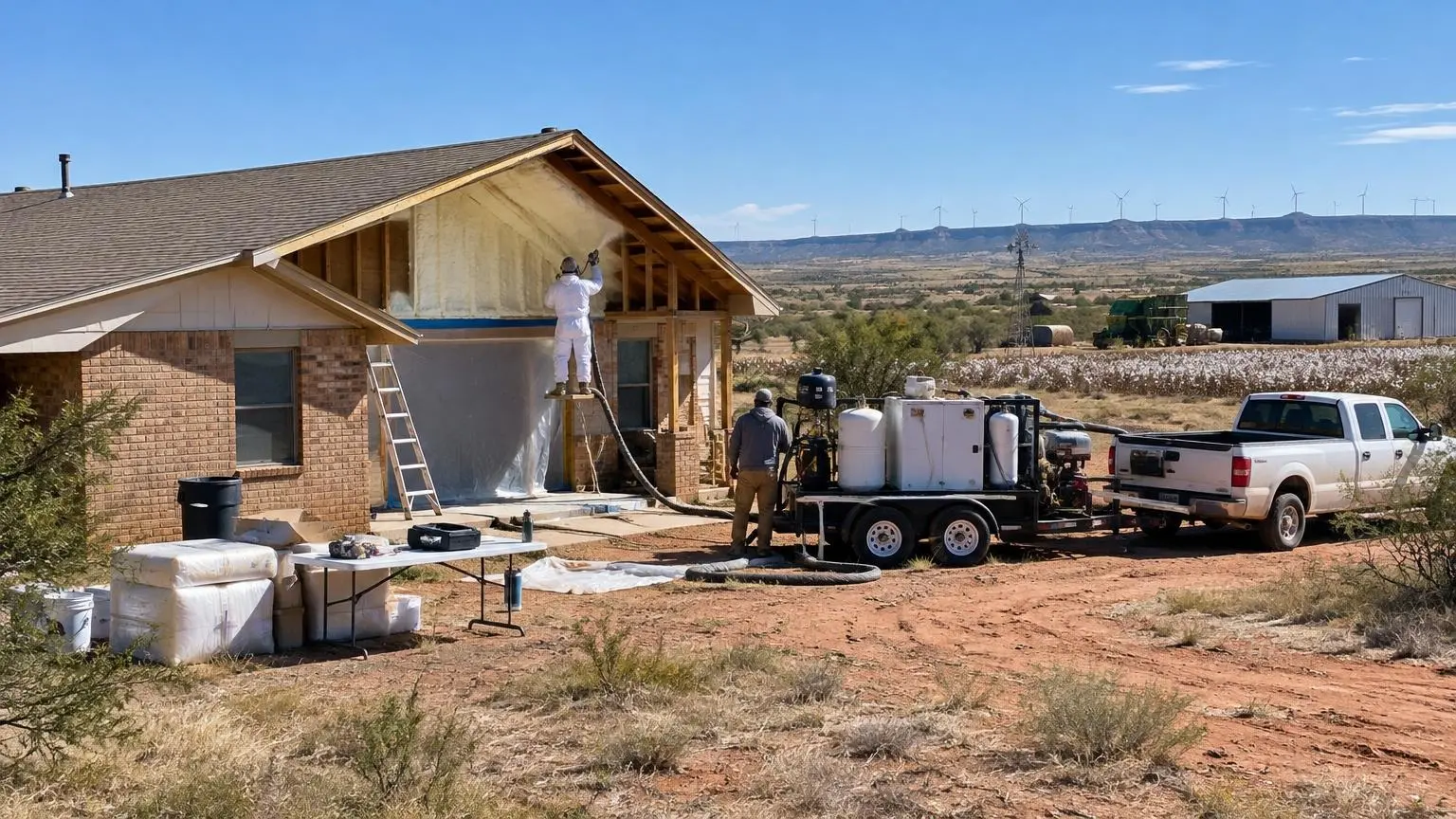
Spray foam insulation in Sweetwater has a job most places do not ask of it: keeping a steady West Texas wind out of the house. Wikipedia calls Sweetwater the Wind Turbine Capital of Texas, and Nolan County has more than 1,500 megawatts of installed wind capacity, built on the same steady breezes that push dust and air through gaps in a house. We seal those gaps and insulate attics, walls, raised floors, shops and barns, using open-cell or closed-cell spray foam where it is the right tool and blown-in insulation where it reaches the same result for less money.
Hot summers, real winters
Sweetwater's semiarid climate swings hard. Neighboring Roscoe, also in Nolan County, has 1991-2020 climate data on Wikipedia showing a July average high of 94.6F, a January average low of 30.8F, a record high of 113F on June 27, 1994, and a record low of -11F on January 5, 1947. It averages about 21 inches of rain and a little over 2 inches of snow a year. A house here needs to block heat in July and hold it in on a January night, and the same air sealing helps with both.
Code targets for Nolan County
OpenEI's county list puts Nolan County in Climate Zone 3B. Texas still uses the energy chapter of the 2015 International Residential Code statewide, according to a 2025 Senate bill analysis, and the Zone 3 table in that code (as summarized by PNNL's Building America Solution Center) calls for R-38 in ceilings, R-20 or R-13 plus R-5 continuous in wood-frame walls, and R-19 in floors. For existing homes, ENERGY STAR suggests bringing a bare Zone 3 attic to R-49, or adding R-38 where there are already three to four inches.
Where Sweetwater houses leak
Sweetwater got its post office in 1879 and the Texas and Pacific Railway on March 12, 1881, and it grew as a rail, cotton, gypsum and cement town. The 2020 census counted 5,130 housing units. Many are older frame or brick homes, and some sit on pier-and-beam foundations rather than slabs. Common leak points include open chases for plumbing and flues, the tops of interior walls, ceiling light fixtures, the attic hatch, and in raised homes, the band joist and plumbing holes in the floor. On windy days those gaps are where the dust comes in.
The EF3 tornado that struck early on April 19, 1986, devastated parts of the south side of town, and homes rebuilt after it sit alongside much older ones. That mix is why we look at every house individually rather than assuming.
Closed cell vs open cell
Open-cell foam is light and soft. It expands to fill cavities, seals air well and quiets sound. HomeGuide rates it at R-3.5 to R-3.7 per inch, and it costs less. It is the common choice under a roof deck when the ducts are in the attic. Closed-cell foam is dense and hard, at R-5 to R-7 per inch, and it slows vapor and does not soak up water. It is our usual pick for steel buildings, the underside of raised floors, and tight spots. The quote names which foam goes where.
Spray foam or blown-in for the attic
For an attic with an open floor and ducts in decent shape, sealing the ceiling and blowing in fiberglass or cellulose is usually the most insulation for the money. If the ducts and air handler are in the attic, or the roof pitch leaves little room, foaming the roof deck moves the ducts inside the conditioned space and can be worth the higher cost. We price both when both fit.
Spray foam insulation cost
HomeGuide's 2026 guide puts spray foam at $1.50 to $5.00 per square foot installed, with open-cell at $1.50 to $3.50 and closed-cell at $3.00 to $5.00. It lists an attic at $3,000 to $8,000 and notes that many installers set a job minimum of $1,000 to $2,000 or more. Blown-in insulation runs $1.00 to $2.80 per square foot in HomeGuide's blown-in guide. These national figures help you plan; your space, the foam type, thickness and any removal set the actual cost, and the written estimate is the price.
How to compare insulation contractors
When you talk to spray foam insulation contractors or insulation companies near Sweetwater, ask the same questions of each. What gets sealed before insulating? Which foam goes where, how thick, and what R-value does that give? How are attic vents handled if the roof deck is foamed? Will exposed foam need a thermal or ignition barrier? How long must the house be empty while it cures (HomeGuide says at least 24 hours)? What happens to the old insulation? A bid without thickness or R-value is hard to compare. Ours lists both.
Shops, barns and steel buildings
Cotton, oil and cattle still drive the economy here, and steel buildings are everywhere: shops, barns, equipment sheds and barndominium shells. Bare steel bakes in summer and drips condensation after cold nights. Closed-cell foam on the panels insulates and stops the drip together. We size the job to how you use the building.
Common Questions
What is the highest R-value spray foam?
Closed-cell foam, rated R-5 to R-7 per inch in HomeGuide's guide, against R-3.5 to R-3.7 for open-cell. Total R-value depends on thickness, so a good quote lists both.
How much does 2 inches of spray foam cost?
Contractors often price foam by the board foot, one square foot one inch thick. HomeGuide's installed prices of $3.00 to $5.00 per square foot for closed-cell assume a typical thickness. Your written estimate will list thickness and price per area.
Can mold grow behind spray foam insulation?
Foam does not feed mold, but trapped moisture behind any insulation can cause problems. We fix leaks first and choose the foam type with moisture in mind.
What R-value does a Sweetwater attic need?
Nolan County is in Climate Zone 3. The 2015 code table Texas uses lists R-38 for ceilings, and ENERGY STAR suggests R-49 for a bare existing attic.
Will air sealing keep dust out on windy days?
It helps a lot. Most dust gets in through the same gaps that leak air, especially around the attic, plumbing and windows.
Do you insulate barndominiums and metal shops?
Yes. Closed-cell foam on the steel is the usual choice for walls and roof, sized to how the building is used.
Our Insulation Services
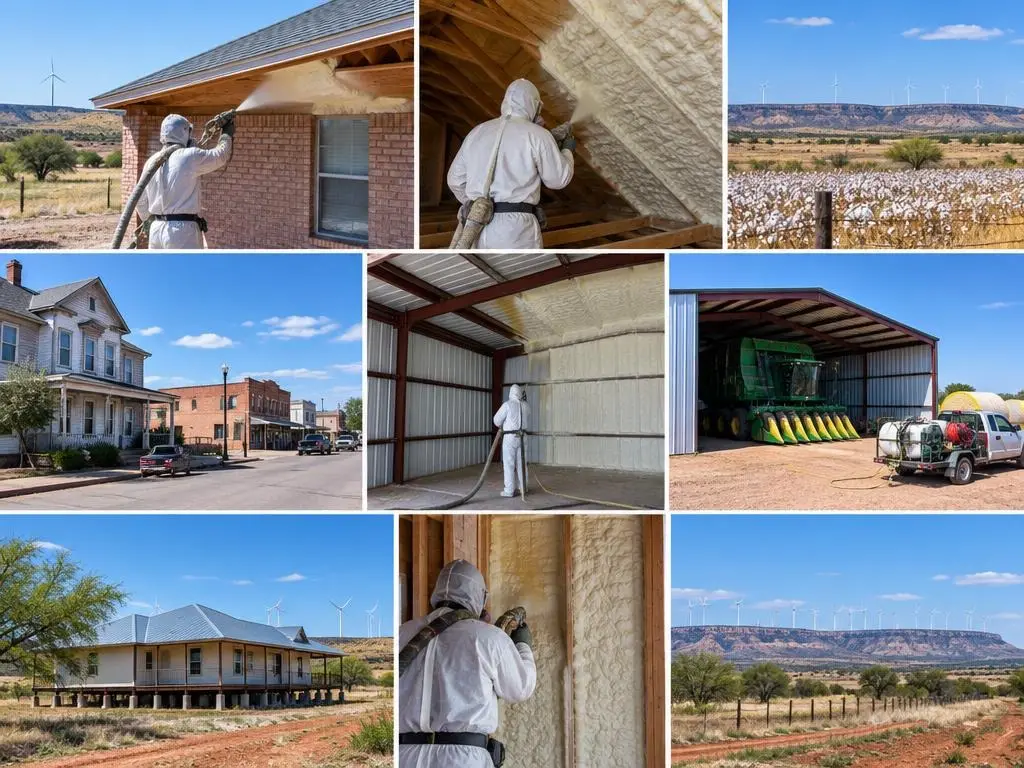
Six services covering every part of a house or outbuilding, from foam on steel to blown-in over a sealed ceiling.
Spray Foam Insulation
Open-cell and closed-cell foam that insulates and air seals in one pass, for roof decks, walls, floors and steel.
Learn more →Shop, Barn & Metal Building Insulation
Closed-cell foam for steel shops, barns, equipment buildings and barndominium shells.
Learn more →Attic Air Sealing & Insulation
Closing the gaps between the house and attic, then bringing the attic up to a Zone 3 R-value.
Learn more →Pier-and-Beam Floor Insulation
Insulating and sealing floors over crawl spaces in raised homes, usually with closed-cell foam.
Learn more →Blown-In Attic Insulation
Fiberglass or cellulose blown across a sealed attic floor, or dense-packed into closed walls.
Learn more →Old Insulation Removal
Removing worn, wet, dirty or rodent-damaged insulation so the attic can be cleaned, sealed and re-insulated.
Learn more →Where We Work
We serve Sweetwater, Roscoe and Blackwell in Nolan County; Loraine and Colorado City in Mitchell County; Snyder and Hermleigh in Scurry County; Roby and Rotan in Fisher County; and Trent and Merkel on the way toward Abilene in Taylor County. Each town page covers what is different there, from older county-seat houses to farm buildings and newer homes.
- Spray Foam Insulation in Sweetwater, TX
- Spray Foam Insulation in Roscoe, TX
- Spray Foam Insulation in Loraine, TX
- Spray Foam Insulation in Colorado City, TX
- Spray Foam Insulation in Snyder, TX
- Spray Foam Insulation in Hermleigh, TX
- Spray Foam Insulation in Roby, TX
- Spray Foam Insulation in Rotan, TX
- Spray Foam Insulation in Trent, TX
- Spray Foam Insulation in Merkel, TX
- Spray Foam Insulation in Blackwell, TX
Why Homeowners Call Spray Foam Insulation Sweetwater
Air sealing first
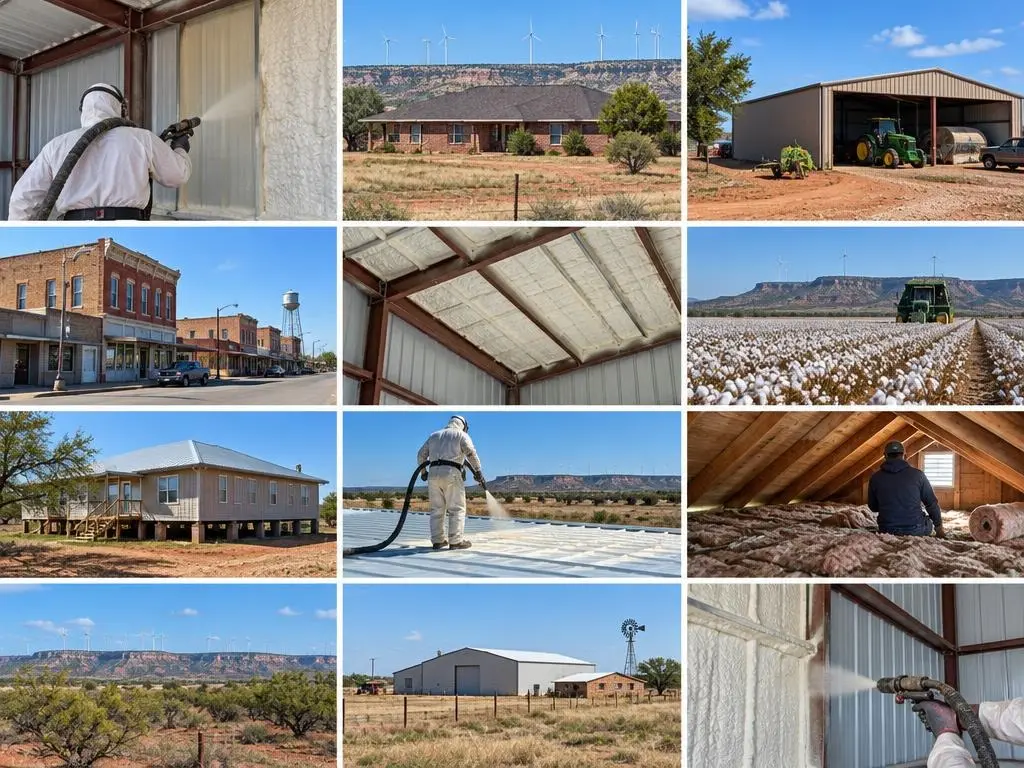
Wind finds every gap, so we close them before adding insulation.
Priced after a visit
We measure and inspect before we write a number.
Foam where it fits
Loose fill where it does the same job for less.
Line-item quotes
Material, thickness, R-value and price for each area.
Get Your Written Estimate
We come out, inspect, and send a written price with the material and R-value for each area.